Key results of field work in the Vitebsk region. Interview with Alexander Subbotin

— Alexander Mikhailovich, how do you assess the past harvesting campaign?
— This year, the development and ripening of grain and leguminous crops, as well as other crops, were slower than usual. This was influenced by various factors, including weather conditions prevailing since the beginning of the vegetation period. As a result, agricultural organizations only massively started harvesting on August 3, whereas last year by this date, 162.5 thousand hectares, or almost half of the grain crops, had already been harvested. Moreover, this year, 353 thousand hectares of grain and leguminous crops were to be harvested, which is more than 40 thousand hectares exceeding the 2021 acreage.
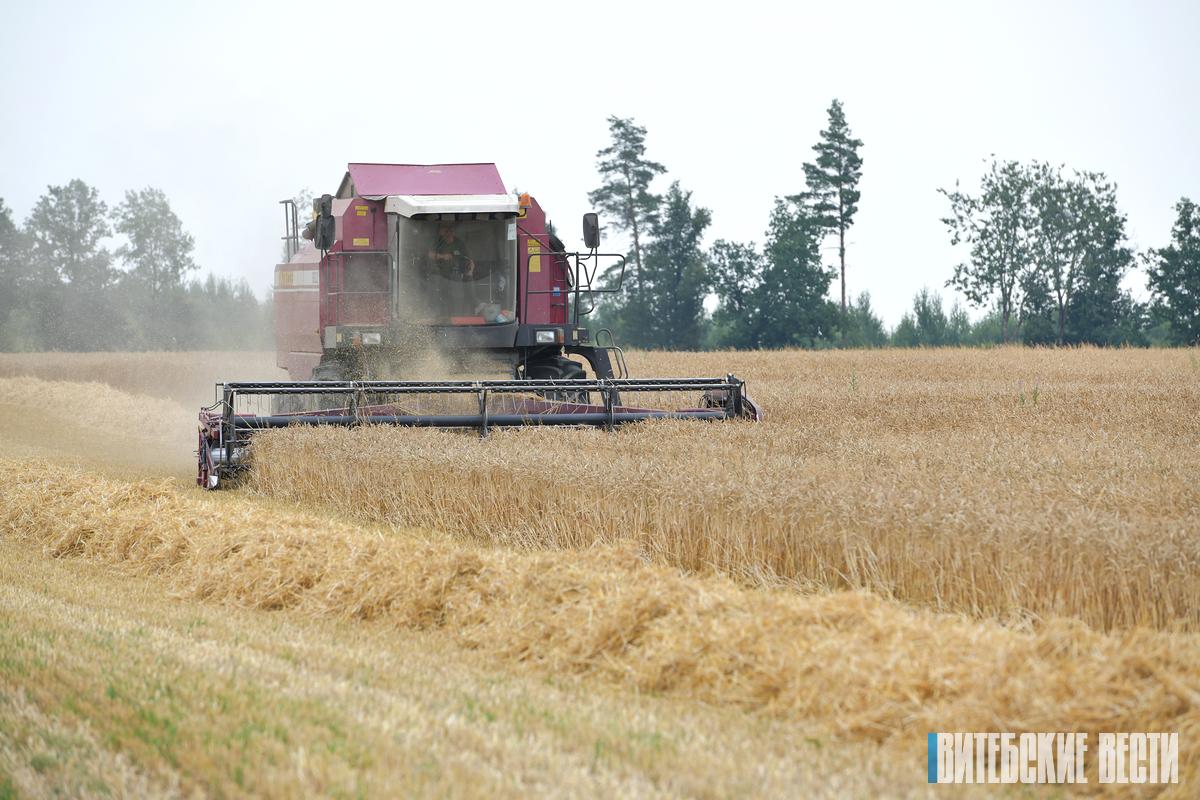
1159 grain harvesting combines were working in the fields, and their readiness was constantly maintained at a level not lower than 95%. The load per combine was about 367 hectares.
Issues of providing machine operators and diesel fuel were addressed. The readiness of equipment was maintained at the proper level.
In districts where there was insufficient equipment, inter-farm teams worked. Farms that completed their harvesting provided technical assistance to other agricultural organizations.
As a result, 1 million 60 thousand tons of grain were harvested in the public sector of Vitebsk region, with an average yield of 30.3 centners per hectare. For comparison, in 2021, 782.2 thousand tons were harvested with a yield of 25.3 centners per hectare.
We believe that the region's agrarians have successfully coped with the task on the grain front. The harvesting campaign was carried out in the shortest possible time and at a high organizational level.
— Which regions and farms made the greatest contribution to the overall harvest?
— The leaders in grain harvesting among districts were Orsha (gross grain yield 128.7 thousand tons with an average yield of 40.7 centners per hectare) and Vitebsk
(117 thousand tons, 41.7 centners per hectare) districts.
Among farms, the best results were shown by three enterprises. OJSC "Vitebsk Broiler Poultry Farm" provided a harvest of over 54.5 thousand tons, surpassing 15 (!) districts in this indicator. 44.1 centners of grain were harvested from each hectare here. Also among the leaders are UP "Rudakovo" (28.1 thousand tons,
37 centners per hectare) and OJSC "Agrokombinat "Yubileiny" (26.7 thousand tons, 50.7 centners per hectare).
Among peasant (farmer) farms, I want to highlight KFH "Terra Gratia" of Senno district. The gross grain yield here amounted to 10.7 thousand tons with an average yield of 40.4 centners per hectare.
— How significant was the assistance from city residents?
— As in previous years, this year, during the period of significant agricultural work (spring sowing campaign, fodder harvesting, and crop harvesting), we are forced to turn to city and district leaders for help in attracting additional human resources. No matter how high-performance modern equipment is, it is impossible to do without people in the field. Given the reduction in the rural population, agricultural producers still experience a shortage of labor.
Throughout the year, over 5,000 people were involved in field work from cities and district centers, including vocational and technical education institutions, among whom about a thousand were specialists in the in-demand trade of machine operator. By the way, during the harvesting period, industrial organizations of the region additionally sent 430 workers, as well as over 170 units of equipment, including tractors, trucks, and loaders.
Taking this opportunity, I want to thank all the heads of urban industrial enterprises and educational institutions that provide assistance to villagers, often even at the expense of their own production processes. Special gratitude goes to those specialists who work directly in the field.
The leaders in grain harvesting among the districts were Orsha (gross grain yield 128.7 thousand tons with an average yield of 40.7 centners per hectare) and Vitebsk (117 thousand tons, 41.7 centners per hectare).
— Alexander Mikhailovich, what is the situation with the fulfillment of the state order for grain and rapeseed oilseeds?
— According to operational data for the first decade of September, agricultural organizations of the Vitebsk region have supplied more than 110 thousand tons of grain for republican state needs, or 99.4% of the target, which is 112.3 thousand tons (including buckwheat and millet). In other words, there is confidence that the state order for grain will be fully fulfilled, as buckwheat and millet are currently being procured for food purposes.
In addition, measures are currently being taken to fulfill the state order for rapeseed oilseeds, of which 35 thousand tons are to be supplied.
— During the visit to the experimental fields in Alexandria in June this year, the head of state indicated the need to change the crop rotation in the Vitebsk region. How is this problem being solved?
— Based on soil and climatic conditions and accumulated experience, the structure of sown areas for crop production needs has been formed for each district. It is based on meeting the needs of livestock for full-fledged feed during the summer grazing period, balanced in energy and protein content, as well as its procurement for winter, taking into account the creation of a reserve stock. In addition, the crop structure takes into account the needs of processing enterprises for agricultural raw materials.
At the same time, we are focusing on more productive winter grain crops. In the total grain area (350 thousand hectares), 240 thousand hectares, or 68%, are allocated for them.
Under the influence of climate change, the conditions for agricultural production are also changing. We are already trying to grow crops that are new to us – sugar beet, soybeans, and sunflowers. The areas under cereal crops – millet and buckwheat – have been expanded.
By the way, the gross grain harvest allows for the full provision of public livestock with feed grain, the demand for which is 600 thousand tons. Currently, pig farms, cattle breeding complexes, and poultry farms are concluding contracts for the purchase of feed grain from the 2022 harvest.
— What needs to be done to make a harvest of 1 million tons or more a routine for Vitebsk region farmers?
— First of all, it is necessary to sow the planned areas of both winter and spring grains on time and, accordingly, to prepare the soil qualitatively for this. Apply the necessary amount of fertilizers, protect plants from weeds and diseases, and harvest on time, i.e., comply with all the requirements of the technological regulations.
— What are your wishes to the grain growers on the eve of "Dazhynki".
— First of all, I want to express sincere words of gratitude to all rural workers and employees of the processing industry for their diligent work, dedication to a difficult but honorable cause. And I wish you all good health, the realization of plans, and new creative ideas from the bottom of my heart.
May your daily, fruitful work for the benefit of your native land bring you only satisfaction and joy. May your homes always be filled with well-being, prosperity, and comfort!
Happy holiday!
In 2022, an average of 34.8 centners of grain per hectare of winter wheat and 30.8 centners of winter barley were obtained, which is also a good result.